
A purjī from C-in-C Bhīma Śamśera instructing the Guṭhī Kharca Aḍḍā
to disburse funds to the Pūrṇeśvarapākaśālā on the occasion of Baḍādasaĩ (VS
1961)
ID: K_0664_0017
Edited and
translated by Astrid Zotter
Created: 2018-06-25;
Last modified: 2024-11-24
For the metadata of the document, click here
Published by Heidelberg Academy of Sciences and Humanities: Documents on the History of
Religion and Law of Pre-modern Nepal, Heidelberg, Germany, 2018.
Published by the courtesy of the National Archives, Kathmandu. The copyright of
the facsimile remains with the Nepal Rashtriya Abhilekhalaya (National Archives,
Government of Nepal).
All use of the digital facsimiles requires prior written permission by the copyright holder. See Terms of Use.
The accompanying edition, translation/synopsis and/or commentary are available under the terms of the Creative Commons Attribution-ShareAlike 4.0 International License .
Abstract
This purjī from Commander-in-Chief Bhīma Śamśera directs
officials of the Gūṭhī Kharca Aḍḍā to release customary sums to the
Pūrṇeśvarapākaśālā for purchasing both gelded goats and ghee and spices to feed the
poor on the occasion of the Baḍādasaĩ festival in VS 1961.
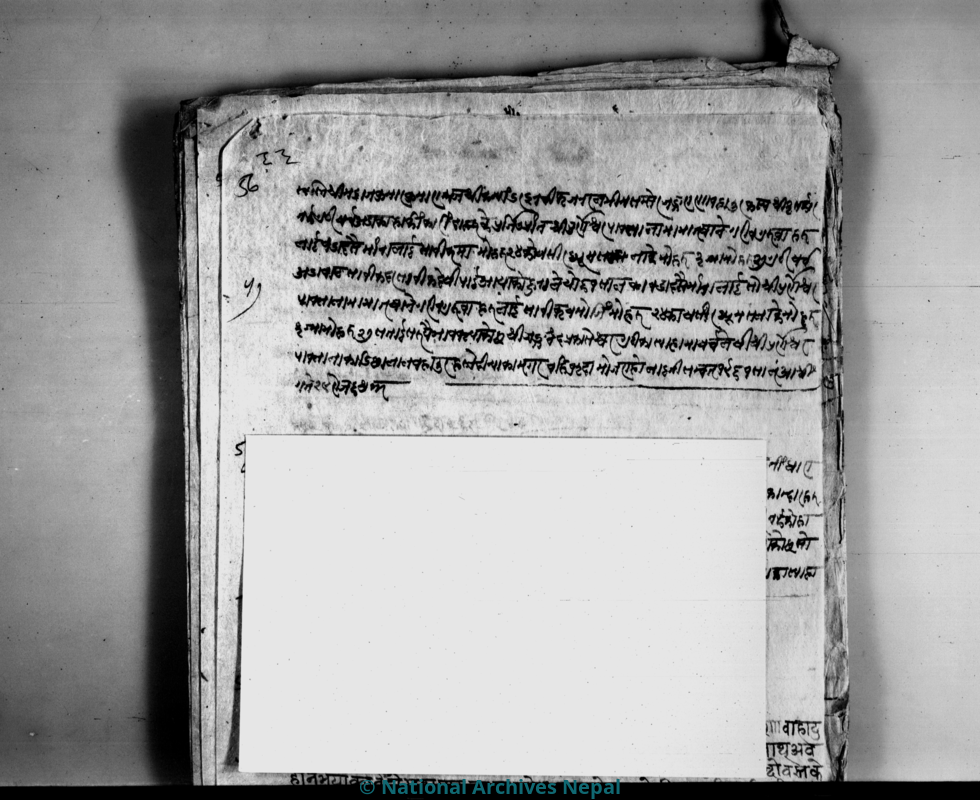
Uprānta: Since the [the pākaśālā] has been
usually receiving 24 mohararupaiyā̃s (text:
moharu) [for] gelded goats and 3 moharus for
ghee and spice(s), in total 27 moharus at the usual rate from the
Guṭhī Kharca Aḍḍā for observing Baḍādasaĩ [with a feast] for
the poor people who take their meals (lit. "cooked rice") at the kitchen
(pākaśālā) of Śrī Purṇeśvara, for the Baḍādasaĩ of the year
[19]61, as usual 24 moharus have been granted for gelded goats and
3 moharus for ghee and spice(s), in total 27—[in words,]
twenty-seven—moharus for observing Baḍādasaĩ for the poor
people who take their meals at the kitchen of Śrī Purṇeśvara. After recording the
expenditures in the account book (syāhā) of the Śrī
Jaṅganaṃdaprakāseśvara guṭhī, carry out the task of delivering
[the money] into the hands of Lāla Bahādura, the diṭṭhā of the kitchen of Śrī Purṇeśvara. It will be deducted
when accounts are cleared.
Saturday, the 29th solar day (gate) of Āśvina in the [Vikrama era]
year 1961 (1904 CE). Auspiciousness.
Commentary
The document orders the disbursement of customary funds to the
pākaśālā of Pūrṇeśvara for buying gelded goats, together with
ghee and spices, as provisions for those who are fed at this kitchen on the occasion
of the Dasaĩ. The present document is written in almost the
same wording as the note to the same effect of the previous year, edited as
K_0660_0052; for further comments, see there.
2. This number was added by a later hand using Arabic
numerals. It refers to the position of the document in the bundle
(pokā) number 10 of the Guṭhī Bandobasta
Aḍḍā under Śrī 3 Sarkāra (cf. registration
number on the catalogue card). It differs by 1 from the number in Indian numerals
given below it, which may represent another (an earlier?) count of the
documents. [⇑]
var. baḍā dasai; also mahā dasaĩ; n. festival to worship the goddess Durgā as slayer of the buffalo demon, held over the bright half of the autumn month of Āśvina. Cf. dasaĩ / daśaĩ.
dasaĩ / daśaĩ
[fr. S. daśāha] var. dasai; n. festival to worship the goddess Durgā as slayer of the buffalo demon, held over the bright half of the autumn month of Āśvina (baḍā dasaĩ) and, on a smaller scale, over the bright half of the spring month of Caitra (caite dasaĩ).
ḍiṭṭhā
var. ḍīṭṭhā, ḍiṭhā; a civil servant ranking above a mukhiyā and lower than a subbā (cf. Stiller 1981: 379). According to Edwards 1975: 107, ḍiṭṭhās originally had been the judges who presided over the courts in Kathmandu but later could serve in a number of other offices (such as the kausī, the hāttīsāra or the sadara daphtarakhānā; see also Kumar 1967: 165; M.C. Regmi 1978: 226). The Mulukī Ain distinguishes three categories of the ḍiṭṭhās; the jaṅgī kote ḍiṭṭhā (probably, combatant personnel), the lājimā ḍiṭṭhā and the ḍiṭṭhā in charge of Elephant or horse stable or cowshed (MA-54.31.11).
guṭha / guṭhi / guṭhī
[fr. S. goṣṭhī] var. guṭh, guthi; n. 1) a socio-religious organization that manages and finances religious and charitable functions, a trust. 2) “endowed lands or other sources of revenue for financing religious and charitable functions“ (M.R. Pant 2002: 132; cf. M.C. Regmi 1988: 267).
Guṭhī Bandobasta Aḍḍā
var. Guṭhī Bandobasta Aḍā, Guṭhi Bandobasta Aḍā; n. "Guthi Administration Office", office responsible for the management of guṭhīs; established under Jaṅga Bahādura Rāṇā in 1852-1853 as replacement of the former Guṭhī Kacaharī. Its foundation marks the change from the guṭhīyāri system of the guṭhī management to the contractor based system; remained the central office to coordinate all offices subsequently established for handling different aspects of guṭhī management, including the Guṭhī Kharca Aḍḍā and others. Separate Guṭhī Bandobasta Aḍḍās managed the śrī 5 sarkāra guṭhīs and the śrī 3 sarkāra guṭhīs (cf. M.C. Regmi 1978: 713-715).
var. mohararupaiyām, mohararūpaiyā, moharaṭaṃkā (New.); often abbreviated as moru, morū, moharu, moharū, moharru, mohorru; n. monetary unit based on and equivalent to two eight-anna silver coins (moharas); in calculations usually broken down into four sukās, 16 ānās or 64 paisās (cf. Pant and Pierce 1989: 93) or 256 dāmas; the exchange ratio with paisās was calculated differently at different times and in different parts of the kingdom, depending on the relative values of silver and copper, ranging between 52 and 80 paisās (Regmi 1982: 73).
In documents sums are represented in four numerical fractions, with the rupaiyā represented by numbers; the sukās by one to three daṇḍas or the avagraha sign representing zero; the ānās by one to three diagonal dashes, sometimes as a loop with two or three jags; the paisās again by daṇḍas or numbers; the dāmas by numbers or horizontal dashes.
purjī
[fr. P. purja] var. purji, pūrjī; n. 1) slip of paper, note. 2) formal letter written by a government institution or an official to another institution or to a person.
śrī 3 sarkāra
lit. "three-times venerable ruler"; title used by the Rāṇā prime ministers (cp. Whelpton 2005: 266).
uprānta
var. uprāṃta, ūprāṃnta, ūprā̃nta, prāṃta; also yathocita uprānta; conj. after that, besides, in addition to, hereafter. In earlier prose and official documents, this word marked the beginning of a text or paragraph. It has no equivalent in English (Clark 1989: 231). In some (mostly Rāṇā period?) documents, it takes the form of yathocita uprānta.