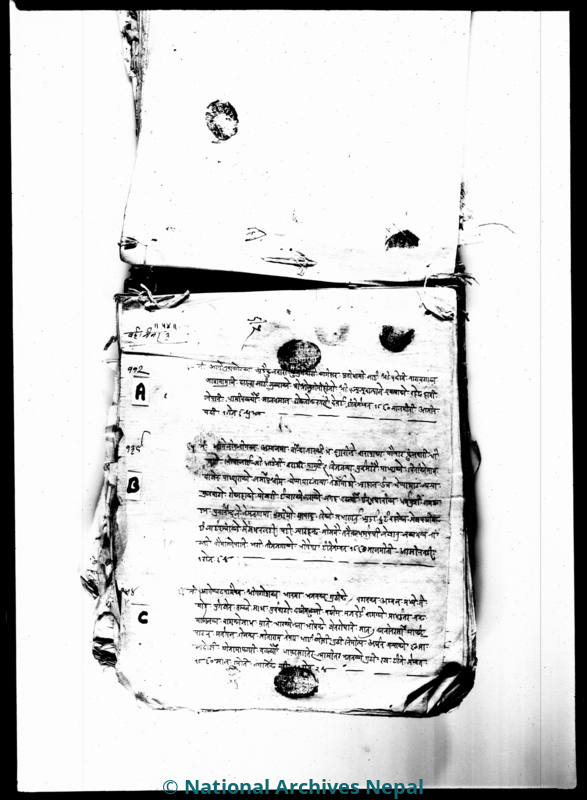
A copy of a lālamohara from King Gīrvāṇayuddha exempting land endowed
to a guṭhī supporting devotional singing from taxation (VS 1860)
ID: K_0001_0035C
Edited and
translated by Rajendra Shakya
in collaboration with
Astrid Zotter
Created: 2018-02-03;
Last modified: 2021-04-20
For the metadata of the document, click here
Published by Heidelberg Academy of Sciences and Humanities: Documents on the History of
Religion and Law of Pre-modern Nepal, Heidelberg, Germany, 2018.
Published by the courtesy of the National Archives, Kathmandu. The copyright of
the facsimile remains with the Nepal Rashtriya Abhilekhalaya (National Archives,
Government of Nepal).
All use of the digital facsimiles requires prior written permission by the copyright holder. See Terms of Use.
The accompanying edition, translation/synopsis and/or commentary are available under the terms of the Creative Commons Attribution-ShareAlike 4.0 International License .
Abstract
The document of which this is a copy exempts land donated by an individual to the
trust (guṭhī) that supports devotional singing
(bhajana) at a Śrī Gaṇeśa shrine in Kathmandu from the
potā tax from the year VS 1860 (1803 CE) onwards.
We have waived the potā tax from the year [VS 18]60 (1803 CE)
onwards [imposed on] the taibāṭe purgakheta4 , a field of seven—[in numbers]
7—ropanīs in the ambala of
Pāṭana, [situated] within the following four
boundaries: a road to the east, a water channel to the south, the boundary of
Majadeū Bāḍā['s property] to the west, and the
boundary of the Naka BāhālaBā̃ḍās' [property] to the north, [and] endowed to the
thāīkomī5guṭhī [established by] Sītārāma Nevāra
of Sartagalaḍola in Pāṭana and [authorized] through
(marphat) KājīNarasīṃ. Keep the guṭhī for devotional
singing running properly, being mindful of your duty.
Monday, the [11th]6 of the dark fortnight of Kārtika in the
[Vikrama] era year 1860 (1803 CE)7 . Auspiciousness.
1. This number likely refers to the position of the document in the
collection from which it was copied. The other entries in the ledger bear similar
numbers. [⇑]
2. This number refers to the position of the document in a
collection of copied lālamohara texts archived under the
numbered classification Pā. Bam. Ta. 1. The bound material, microfilmed
sequencially from K 1/20 (index) up to K 4/33, covers the main body (i.e.
excluding the initial and final formalities) of 468 royal documents from the
period VS 1830–1894. [⇑]
3. Bhajanas are often performed in front of a
deity/shrine (as probably was done in the present case) or in public resthouses
called phalcās by Newars (Nep. pāṭī). [⇑]
4. It is
not clear what specific tract of land this refers to. The words could either
denote a type of field or be a place-name. [⇑]
5. The writing here is not clear. The
word could denote the type of guṭhī, maybe misrepresenting some
Newar word. [⇑]
6. The lunar day (tithi) is not
clearly visible due to the ink mark of a seal. The most likely reading appears to
be 11, but this would not tally with the weekday. Only tithis 1
and 9 would yield a Monday. [⇑]
7. According to the date, the issuer
of the original lālamohara must have been King Gīrvāṇayuddha [⇑]
8. The akṣaras following the
word shī, "signature", are unclear. They must represent the
signature of the scribe involved in checking the copied documents for their
correspondence with the originals. The same signature is present in other copies
in the same ledger. From a comparison with places where it is more clearly
written, the most likely reading would be Dīdī, followed by another
akṣara. [⇑]
Glossary
Word
Notes
āge
[fr. S. agre] adv. lit. "henceforeward" (Riccardi 1976: 150 n. 6), especially used in administrative and legal documents to mark the beginning of a text or paragraph. In its function it is similar to uprānta.
akṣara
[S.] n. letter of the alphabet; syllable.
ambala
var. aṃbala, amavala, amala, amāla, ammala; n. 1) territory, administrative unit, district. 2) office, position, term of office, honour, respect (Turner 1931: s.v. amal); "territory in Gorkhali official discourse; land occupied by force, land from which the state has acquired right to collect revenue; generally conveys the same meaning as the term amal" (Michael 2012: 129). 3) a Limbu subbā's court or council in Pallo Kirāta (Caplan 2000: 225).
bā̃ḍā
[fr. Skt. vandya] var. bāḍā, vāḍā; n. generic term commonly used by non-Newars to refer to the two highest Buddhist Newar sub-castes, the Śākya and Vajrācārya, who traditionally work as goldsmiths amongst others; the Mulukī Ain groups them below the Śreṣṭhas (MA-54 145.8).
bhajana
[S.] n. lit. "the act of sharing, partaking." 1) praising a revered being, such as a deity or a guru, by singing devotional hymns or songs. 2) devotional hymn or song for praising a revered being, such as a deity or a guru.
guṭha / guṭhi / guṭhī
[fr. S. goṣṭhī] var. guṭh, guthi; n. 1) a socio-religious organization that manages and finances religious and charitable functions, a trust. 2) “endowed lands or other sources of revenue for financing religious and charitable functions“ (M.R. Pant 2002: 132; cf. M.C. Regmi 1988: 267).
kājī
var. kāji, kāzī; n. “an officer of ministerial rank superintending civil and military affairs“ (M.R. Pant 2002: 133; cp. Edwards 1975: 105).
lālamohara
var. lālmohara, lālamohar, lālmohora; abbreviated mohara; n. royal document bearing the red seal.
mārphat / mārphata
var. marphaṭ, mārphaṭa, marvaṭ; "through (the person of)" (Pant and Pierce 1989: 93).
potā
n. a tax imposed on certain categories of birtā-lands. According to D. Vajrācārya, it was introduced by King Pratāpasiṃha (Vajrācārya VS 2019: 39). The document PD_0002_0002, however, mentions the exact year of the introduction of potā as NS 893 (1773 CE) which was still during the reign of King Pṛthvīnārāyaṇa.
[S.] n. word of blessing, can be used as apprecatio, in which case it means 'good fortune' (Pant and Pierce 1989: 12), can be used as a prefix to names of persons and gods, in which case it means 'venerable' or 'glorious' respectively. The number of śrīs used varies, depending on context.

 .
.