A letter from Dalabhañjana, Balabhañjana and Raṇagambhīra Pāṇḍe ordering newly appointed dvāres not to overcharge when collecting the fee owed them by local functionaries upon their arrival (VS 1885)
ID: L_1200_0020
Edited and
translated by Rajendra Shakya
in collaboration with
Rabi Acharya
Created: 2018-11-19;
Last modified: 2021-07-09
For the metadata of the document, click here
The accompanying edition, translation/synopsis and/or commentary are available under the terms of the Creative Commons Attribution-ShareAlike 4.0 International License
 .
.
Abstract
This letter from three senior officers instructs newly appointed dvāres not to inflate the fee owed them by local headmen upon their arrival, after the rate had risen to 30 instead of the usual five rupees.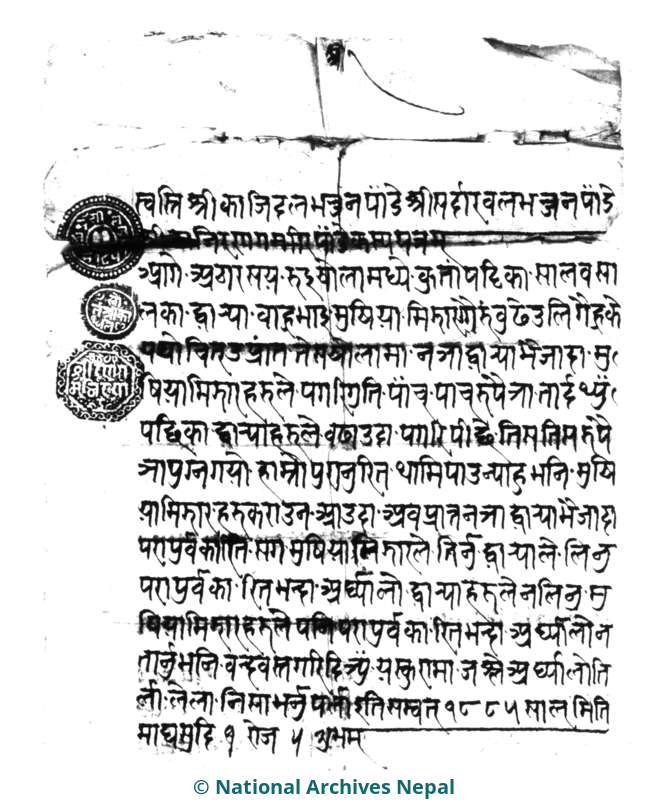
Diplomatic edition
[1r]
1श्री\[Seal of Dalabhañjana Pāṇḍe][Unknown seal][Seal of Raṇagambhīra Pāṇḍe]1स्वस्तिश्रीकाजिदलभन्जनपाँडेश्रीसर्दारवलभन्जनपाँडे2श्रीकाजिरणगम्भीरपाँडेकस्यपत्रम्———–
3आगे∙अठारसय़∙रुइषोलामध्ये∙कुतांपट्टिका∙सालवसा
4लका∙द्व़ार्या∙वार्हभाइ∙मुषिय़ामिझारगौरुंवुढेउलिगैर्हके
5यथोचित्उप्रांत∙तेसषोलामा∙नञा∙द्व़ार्याभैजादा∙मु
6षिय़ामिझारहरुले∙पगरिगुति∙पाँच्∙पाँच्रुपैञा∙तार्दथ्युँ
7पछिकाद्व़ार्याहरुलेवढाउदा∙पगरिपीछे∙तिसतिसरुपै
8ञापुग्नगय़ोहाम्रोपुरानुरित∙थामिपाउन्याहुभनि∙मुषि
9य़ामिझार∙हरुकराउन∙आउदा∙अवप्रान्तनञाद्व़ार्याभैजादा
10परापूर्वका∙रित∙संगमुषिय़ामिझारलेतिर्नुद्व़ार्याहरुले∙लिनु∙
11परापूर्वका∙रितभन्दा∙अर्घ्यालो∙द्व़ार्याहरुलेनलिनु∙मु
12षिय़ामिझारहरुलेपनिपरापूर्वका∙रितभन्दाअर्घ्यालोन
13तार्नुभनि∙वन्दवस्तगरिदिञ्युँ∙य़स्कुरामा∙जश्लेअर्घ्यालोति
14र्ला∙लेला∙निसाभर्नुपर्लाइतिसम्वत्१८८५साल्मिति
15माघसुदि१रोज५शुभम्——————
Translation
[1r]
[Seal of Dalabhañjana Pāṇḍe]
[Unknown seal]
[Seal of Raṇagambhīra Pāṇḍe]
Hail! A letter from Śrī KājīDalabhanjana Pā̃ḍe, Śrī SardāraBalabhanjana Pā̃ḍe [and] Śrī Kājī Raṇagambhīra Pā̃ḍe
Āge: To the dvāres, bāhrabhāimukhiyā1 , mijhāra, gauruṅ, buḍhyaulī and the like [who are posted] on a yearly basis to [the area] towards Kutāṃ on the Rui River in the Aṭhāra Saya [Kholā] region.
Yathocita uprānta: “Whenever [any government officer] came as a newly appointed dvāre to that river2 , [we] mukhiyās and mijhāras, put on a pagarī3 [received from him] and paid him five rupees [each]. Dvāres [posted here] later increased [the pagarī charge till] it reached thirty rupees per pagarī. We deserve to have our old customs retained.”
As the mukhiyās and mijhāras came to make such complaints, we have made the following arrangement: “From now on when a new dvāre goes there, they shall not take an amount in excess of the old custom; nor shall mukhiyās and mijhāras pay an amount in excess of the old custom.” In this regard, whosoever pays or takes in excess shall be brought to book.
Thursday, the 1st of the bright fortnight of Māgha in the [Vikrama] Era year 1885 (1829 CE). Auspiciousness.
Commentary
Three senior officers instruct dvāres posted to the Kutang region not to overcharge local functionaries for the pagarī, which was set at a fixed rate. That the revenue offcials were apparently tempted to find other ways to increase their take is documented by letters sent by commanding generals in the same region on later occasions that, more generally, give strict instructions not to increase the tax burden on local functionaries and ryots.